Walk with me: Remembering a friend
- wwsmith6410
- Dec 31, 2025
- 5 min read
Updated: Feb 1
(First appeared in The Baldwin Times/Gulf Coast Media, 11-07-25)
“Learning to walk again. I believe I’ve waited long enough, where do I begin?”
- Foo Fighters, “Walk”
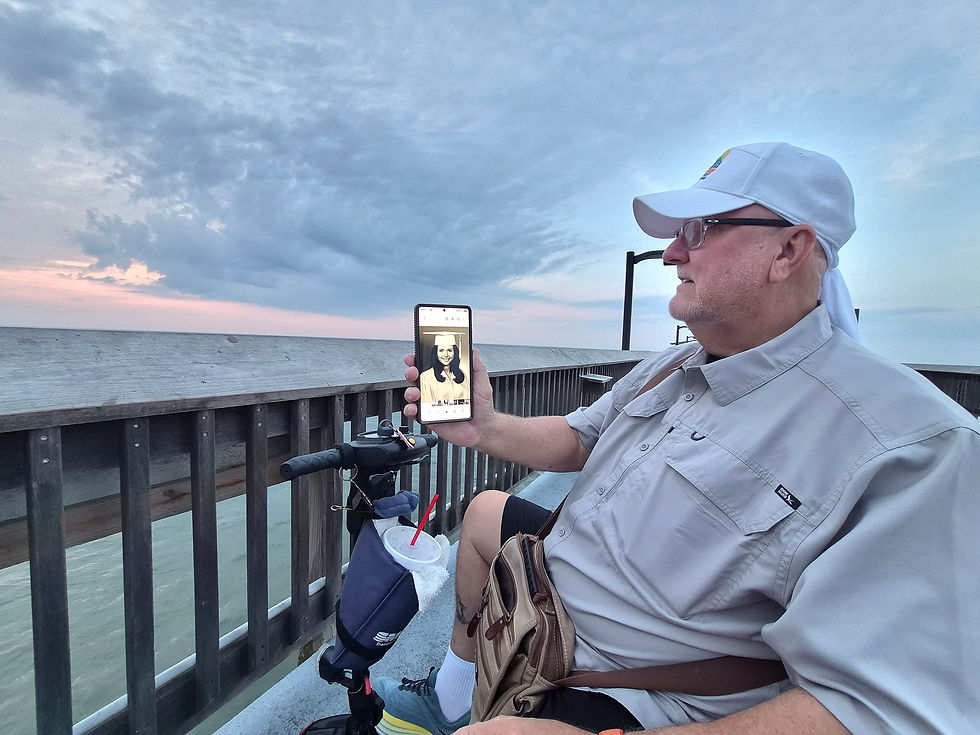
I’m gradually losing my ability to walk. Or at least the ability to do so without some assistance.
It’s the result of a genetic condition I was diagnosed with in the fall of 2024 – the same time Dorinda was undergoing cancer treatments. I am trying to take it easy. Trying to be careful and trying not to fall. Trying to stay positive. Trying not to give up. It is hard to do, especially without her.
I don’t have to look too far for inspiration. I watched my wife bravely go through dozens of chemo and radiation treatments, and never once ask did she ask why cancer was happening to her. Instead, when family members called or visited to check on her, she would always be positive and smile. Until the very end.
I also can point to another close friend of ours who maintained a positive outlook even when facing a myriad of health issues. I’d like to tell you about Steve Beavers.
I first met Steve on a softball field in Florence when my daughter was taking part in tryouts for a 6- and 7-year-old softball league. Steve was tossing softballs to the young girls, sitting in his scooter a few feet in front of the pitching mound. We hit it off almost immediately when we discovered his daughter and my daughter looked remarkably alike. When they were 6 years old, they could have easily been mistaken as twins.
Steve and I shared a laugh about that, struck up a conversation and began a lasting friendship. After years of struggling with health problems, Steve died Dec. 22, 2020. He was 62.
Steve suffered from a genetic disorder that left him unable to walk. But he was at every baseball or softball game involving his son or daughter. Every practice. He would pull up in his van, ease out of the door with canes and somehow manage to unload his scooter by himself. You could offer to help, but he would always say he didn’t need any.
He loved talking about Alabama football, eating Mexican food with friends, and talking about his children. And he was always interested in how I was doing – how was my family, my health, my work. He would listen and smile. He cared.
Steve wasn’t interested in lamenting about his own health struggles. For someone facing the physical challenges he endured, I’ve never met anyone with a more optimistic outlook on life. On my worst days – and my best – I hope that’s something I will remember about Steve.
Here’s something for you to know about him: His wife, Leanne, recalled a particular visit to Gulf Shores several years ago with their two children.
“We had gone to the pool at the condo where we were staying,” Leanne said. “Our kids were young and Steve was able to get in the pool from his wheelchair to play with them. When he got out of the pool, a young woman walked with some difficulty over to talk to Steve. She said, ‘You are in a wheelchair but you seem so happy. Why?’
“Steve replied, ‘God has blessed me with a wonderful family, home, friends and life. I have no reason to not be happy.’ They talked for a while, sharing their stories with each other.”
That’s really all you need to know about him. By coincidence, perhaps, I suffer from a similar genetic condition as Steve. I learned that about 20 years after initially meeting him on the softball field that day. His was a different variant and affected him much earlier in life, and was combined with other health issues. The condition affects only about 20 people per 100,000 worldwide. So, I don’t think it was an accident that I met Steve.
I asked Leanne more about his years living with his health issues and how he maintained such a positive outlook. I’ll let her tell his story. It’s one I needed to hear.
“When Steve was 19 years old, he was playing touch football with his nephews. He noticed he wasn’t able to cut to the left/right like he had been able to do. This is when he realized that he might have a condition like his older brother. He continued to play organized sports - softball, volleyball, basketball and bowling until he was 35 years old. At this time, his gait and balance made it too difficult to play. However, he continued to be a sports fanatic and watched every sport imaginable on TV or live. He especially enjoyed watching his son and daughter play ball.
“He was formally diagnosed at age 35. We made the decision that his condition would be a part of our life but our life would not revolve around it. Steve had to make a big adjustment when he could no longer work and had to go on disability at the age of 42. At first, he was lost and didn’t know what to do. Then, he took over a lot of the household duties and began to find his way. He loved to buy groceries because he loved talking to people. He soon realized that being in a wheelchair opened many doors of conversation with complete strangers. Steve loved helping others and soon found that he could share his story with other people who needed someone they could relate to.
“As time passed, Steve’s condition became more pronounced. Sometimes he was frustrated at things he couldn’t do by himself – he was fiercely independent. But we learned to compensate for this by finding ways to make things easier for him. We also learned he was able to share Christ with more people by sitting in a wheelchair than by standing on two feet.
“Steve always put others before himself and did whatever he could to help. An example of this was at the ball field when our daughter was playing softball. Her coach had 1-year-old twin girls. He had to bring them to the ball field with him on this particular day. He had them in a stroller together on the pitching mound so he could pitch to the girls on his team. At this time, Steve was using a motorized scooter to help him get around. He put each twin on his knees and rode them all around the ball field so their dad could coach his little team of 6-year-old girls. Needless to say, the twins enjoyed every minute of their ride and so did Steve.
“Steve knew what was important in life. Maybe it was in part because he had a difficult childhood. He didn’t have a stable home life or roots. He was able to watch his children grow in a Christian home with love and without conflict. He built a home in the country, a dream he never imagined would come true. But he knew none of this was by his own hands. He had to quit working at 42 years old. He knew everything he had was from God, even his disability. It certainly wasn’t easy to deal with, but he understood why.”
I thanked Leanne for sharing Steve’s story with me. Maybe it will help someone else reading this who is struggling with health issues or other problems. If so, Steve is continuing to impact others.
No doubt, I think Steve Beavers was a part of my life those years ago to show me how to live with a potentially debilitating condition. He gave me an example to follow as far as keeping a positive outlook.
Dorinda followed such a pattern.
I am trying.



Comments