From Apollo to Artemis: The moon is calling again
- wwsmith6410
- Apr 24
- 4 min read
(First appeared in The Baldwin Times for Gulf Coast Media on April 17, 2026.)

By Wayne Smith
Gulf Shores Media Contributor
Before heading off to school on the morning of April 7, my oldest grandson sat on my lap as we watched recorded videos of Artemis II launching a few days earlier.
With the countdown underway, Rhys joined in.
Ten, nine, eight …
Rhys, 5, watched in amazement as the rockets of the Space Launch System (SLS) fired, lifting the Orion capsule and its crew toward the moon. I remember that feeling.
Because on July 20, 1969, I turned 5 years old on the day man first walked on the moon.
It’s the first clear memory I have — one forever tied to my birthday. The day NASA’s Apollo 11 mission fulfilled President John F. Kennedy’s goal of putting a man on the moon before the decade was out.
Neil Armstrong and Buzz Aldrin walked on its surface. Armstrong’s words still echo all these years later:
“That’s one small step for man, one giant leap for mankind.”
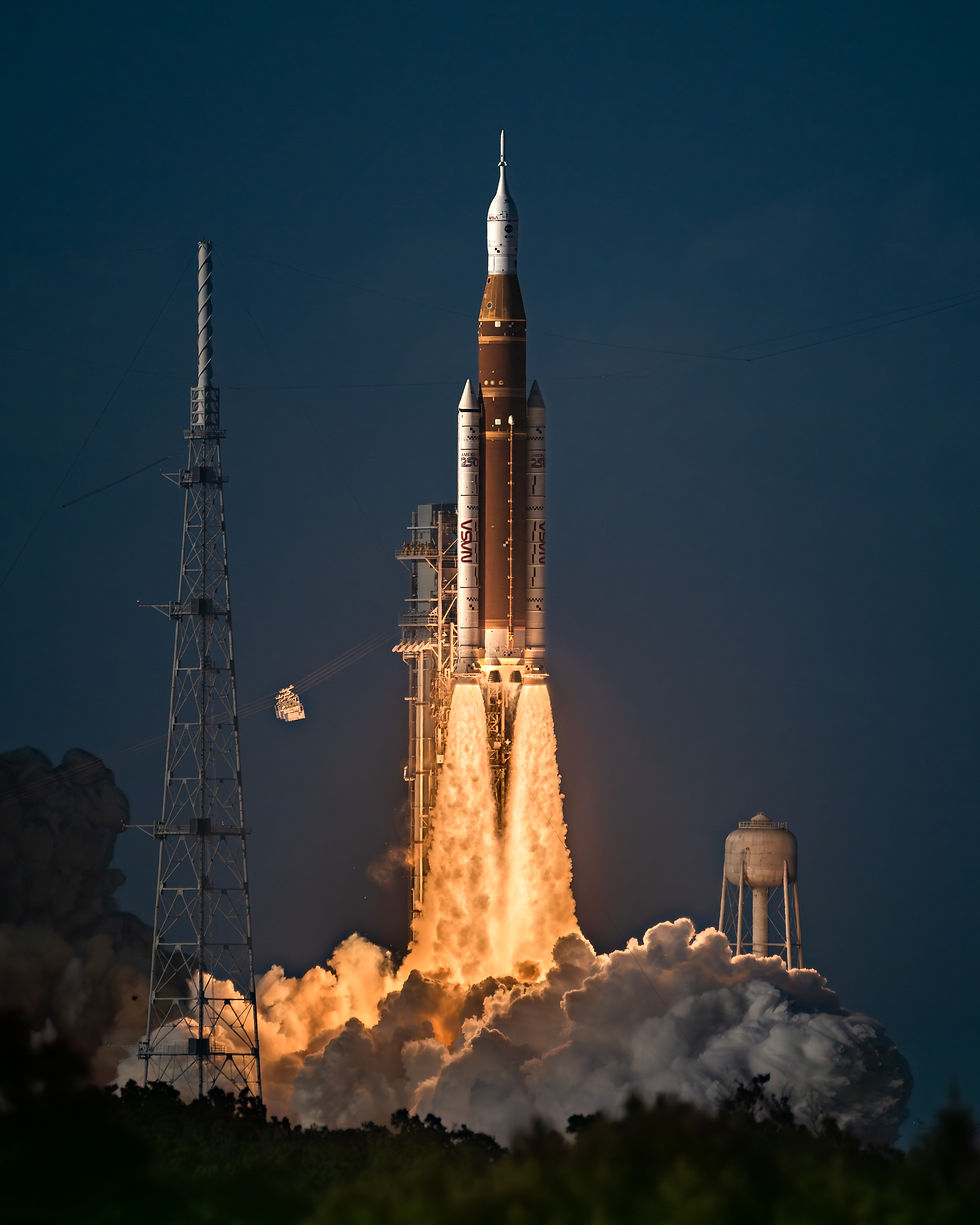
Watching my grandson’s eyes widen as that rocket lifted off, it felt like something coming full circle. Like a passing of the torch. Appropriately, we took him to Kennedy Space Center on his first birthday in 2022.
I didn’t fully understand what I was seeing back in 1969 watching the moon landing. But I knew it mattered.
It still matters.
I had a blue metal lunchbox commemorating the moon landing. I carried it for years, filled with baseball cards and pieces of childhood. I wish I still had it.
Because what it represented never really left.
There were more Apollo missions. Then the space shuttle. The International Space Station. And through it all, much of that work happened right here in Alabama at NASA’s Marshall Space Flight Center.

In 2021, my career took me there.
I worked in communications and later as editor of The Marshall Star, telling the stories of the people building the next chapter of space exploration.
On my first visit to the campus, I walked through places that felt almost sacred — Rocket Park, the historic test stands, the buildings where space station operations are monitored around the clock.
I met engineers, technicians, and astronauts. People doing the kind of work most of us only see from a distance.
People like Chris Baker — an engineer and photographer who captured the launch images accompanying this column.
Back then, Artemis wasn’t a launch.
It was PowerPoints. Schedules. Questions.
Critics were loud. Timelines slipped. For a long time, the rocket existed more on paper than on a launch pad.

Not anymore.
Four, three …
When Artemis II lifted off earlier this month, I wasn’t writing on deadline. I was at the beach. And I was fine with that. Because I had already seen this story from the inside.
And now, I was watching it from the outside — sitting with my grandson, just like so many families once did in 1969.
That’s what made it matter.
Apollo 11 wasn’t just a mission. It was a signal — to a generation that looked up and believed there was more out there.
Somewhere along the way, we stopped looking up as much.

Enter Artemis — considered the twin sister of Apollo in Greek mythology — and the mission that took four astronauts around the dark side of the moon.
Quieter. More deliberate. Built over time instead of driven by urgency. Maybe that’s what makes it meaningful now.
I hope the Artemis Program continues, that NASA’s plan for space exploration moves forward. That it doesn’t fall victim to budget cuts.
Because somewhere, someone was watching this — seeing the sky light up, feeling the ground shake — and realizing it’s still possible to go.
That the story didn’t end in the summer of ’69. That was the beginning. It paused.
And now, it’s moving again.
Maybe there will be new metal lunchboxes celebrating this generation of astronauts, with their pictures emblazoned on them.
Maybe one of those pictures will be one of my grandchildren.
Or one of yours.
Two, one …
Liftoff.
Wayne Smith has worked as a writer and editor at newspapers across Alabama, Florida and South Carolina. His weekly column focuses on navigating Gulf Shores alone after losing his wife to cancer, and the places he discovers and the people he meets. Read his previous columns at www.GulfCoastMedia.com. Contact him at wwsmith6410@gmail.com.



Comments